
What a loyalty program actually is, the structures available to you, how the mechanics fit together, what the law now requires, and how to choose one that grows repeat revenue instead of just handing out discounts.
Walk into any kopitiam, pharmacy, salon, or boutique in Malaysia and you will find the same quiet problem behind the counter. Plenty of people come in. Few of them come back on purpose. The owner can see the day's sales, but cannot see who those customers were, whether they will return, or how to reach them when they don't. A loyalty program is the system that closes that gap. Done well, it turns anonymous walk-ins into named, reachable customers who choose you again — and gives you the data to know whether that is actually happening.
This guide is written specifically for Malaysian small and medium enterprises (SMEs): the F&B outlets, retail shops, clinics, salons, and service businesses that make up the backbone of the local economy. It is deliberately definitional. Before you compare apps or chase the cheapest plan, it pays to understand what these programs are, the forms they take, the parts that make them work, and the rules — particularly the recently strengthened Personal Data Protection Act — that now govern how you can contact the customers you collect.
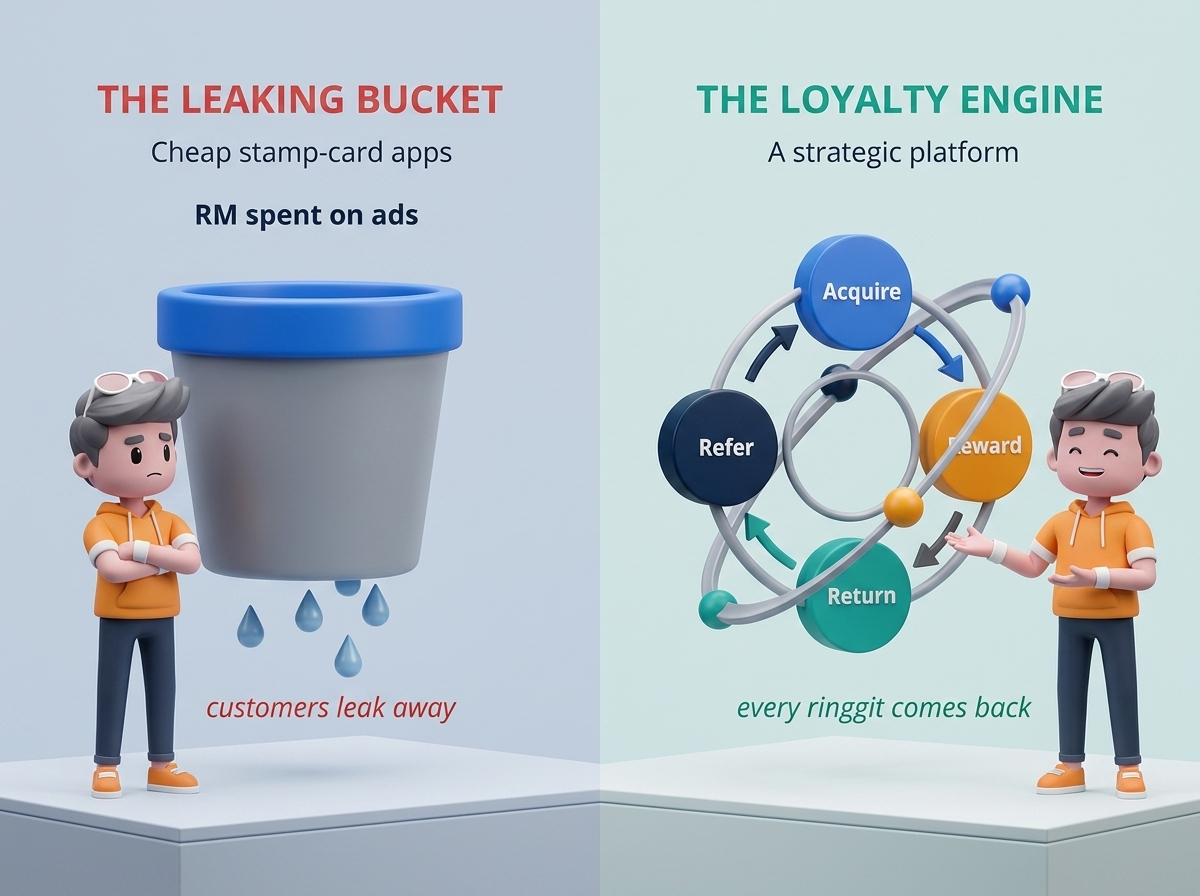
Figure 1. A loyalty program turns a leaking bucket of one-time visits into a repeatable engine of return visits.
What Is a Loyalty Program? A Clear Definition
A loyalty program is a structured system that rewards customers for repeat behaviour — usually repeat purchases — in order to increase how often they buy, how much they spend, and how long they stay. That is the textbook definition. But for an SME owner, a more useful working definition is this: a loyalty program is the mechanism by which you capture a customer’s identity, give them a reason to return, and earn permission to contact them again.
Notice that this definition has three moving parts, and rewards are only one of them. Capture (knowing who the customer is), incentive (a reason to come back), and permission (the legal right to reach them) are equally important. A punch card that gives a free coffee on the tenth stamp delivers an incentive but captures no identity and earns no permission — so when the customer drifts away, you have no way to win them back. A well-built program does all three at once.
It helps to separate three terms that are often blurred together:
- Loyalty program: the overall system of rules, rewards, and tracking that encourages repeat business.
- Loyalty scheme or mechanic: the specific way customers earn — points, stamps, tiers, cashback. One program can run several mechanics.
- Rewards or perks: the actual benefits a customer receives — a discount, a free item, early access, a birthday treat.
Keeping these distinct matters, because most owners obsess over the reward (“how big a discount?”) when the program and its mechanics are what really decide whether the thing works.
Why Loyalty Programs Matter Specifically for Malaysian SMEs
Customer loyalty is universal, but the Malaysian SME context shapes what a good program looks like. Four local realities are worth naming directly.
1. Customers are highly price-aware and spoiled for choice
Malaysian consumers compare prices instinctively and switch easily. A neighbouring outlet, a Shopee voucher, or a Grab promo is always one tap away. Competing on price alone is a race you cannot win against larger players. A loyalty program lets you compete on relationship and accumulated value instead — a customer who is three stamps away from a reward, or who has RM18 of store credit sitting in your wallet, has a reason to choose you that has nothing to do with being the cheapest.
2. Most businesses are walk-in heavy and data-poor
The typical SME processes dozens or hundreds of transactions a day and keeps almost none of the customer information. The sale closes, the customer leaves, and the relationship resets to zero. The single biggest jump in value for most Malaysian SMEs is simply moving from anonymous transactions to identified customers — and a loyalty program is the most natural reason to ask for a phone number at the counter.
3. WhatsApp is the default channel
In Malaysia, WhatsApp is where business actually happens. Open rates dwarf email, and customers expect to hear from businesses there. This is a genuine advantage — a reminder or reward sent by WhatsApp gets seen — but it raises the stakes on consent, because the same law that protects customers also restricts how you may message them. More on that below.
4. The cost of acquisition keeps climbing
Paid reach on social platforms gets more expensive every year, and it is widely estimated that acquiring a new customer costs roughly five times more than retaining an existing one. Every ringgit spent bringing a customer back through a loyalty program tends to work harder than a ringgit spent buying a brand-new stranger’s first visit. For a business with a tight marketing budget, retention is not a nice-to-have — it is the most efficient growth lever available.
| The core idea in one sentence For a Malaysian SME, a loyalty program is less about “giving discounts” and more about building a reachable customer base you own — so you are never starting from zero each morning. |
The Main Types of Loyalty Programs (and When Each Fits)
“Loyalty program” is an umbrella term. Underneath it sit several distinct structures, each rewarding customers in a different way and suiting a different kind of business. Understanding the menu is the first step to choosing well.
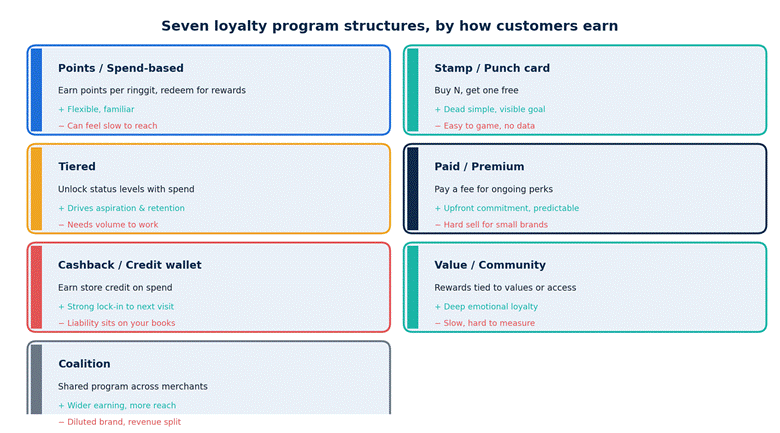
Figure 2. Seven common loyalty structures, grouped by how customers earn — each with a trade-off.
Points / spend-based programs
Customers earn points for every ringgit spent and redeem them for rewards. This is the most familiar and flexible structure. It works well when purchases are frequent and varied — cafés, pharmacies, grocers. The risk is that points feel slow to accumulate; if a customer needs months to earn anything meaningful, the incentive fades. Good points programs make the first reward reachable quickly.
Stamp / punch-card programs
Buy a set number of items, get one free (the classic “buy 9, get the 10th free”). Their strength is simplicity and a visible goal. Their weakness is that a paper card captures no customer data and is easily gamed. A digital stamp card keeps the simplicity while capturing identity — the best of both.
Tiered programs
Customers unlock status levels — Silver, Gold, VIP — as they spend or visit more, with better perks at each level. Tiers tap into aspiration and are powerful for retention because customers work to keep a status they have earned. They need enough customer volume and spend frequency to be worthwhile; a business with very occasional purchases will struggle to make tiers feel alive.
Paid / premium membership
Customers pay a fee — monthly or annual — for ongoing benefits (think a coffee subscription, or a clinic membership with member pricing). Because the customer has paid to join, commitment and repeat visits are high, and you get predictable revenue. The trade-off is that it is a harder sell, and usually only works once a brand has earned real trust.
Cashback / credit-wallet programs
Instead of points, customers earn store credit they can spend on a future visit. Psychologically this creates strong lock-in — money “in your wallet” at a specific business pulls the customer back. The thing to manage is that outstanding credit is a liability on your books, so the earn rate needs to be costed carefully.
Value-based and community programs
Rewards are tied to shared values, exclusive access, or belonging rather than pure transactions — a donation on the customer’s behalf, members-only events, early access to new products. These build the deepest emotional loyalty but are the slowest to show up in sales figures and the hardest to measure. They suit brands with a strong identity.
Coalition programs
Several merchants share one program, so customers earn and redeem across all of them (the model behind large points coalitions). Reach is wider, but your brand is diluted and the economics are shared. For most independent SMEs, a program you own outright is a better starting point than joining someone else’s coalition.
| How to read this menu You do not have to pick only one. A café might run a digital stamp card for everyday visitors and a paid “coffee club” for regulars. Start with the simplest structure that captures identity and earns a return visit — then layer on complexity only when the numbers justify it. |
The Anatomy of a Loyalty Program: How the Loop Works
Whatever structure you choose, a working loyalty program is really a loop with five connected parts. Most failed programs are not failed structures — they are broken loops, where one part is missing and the chain never completes. Build the loop before you add decoration.
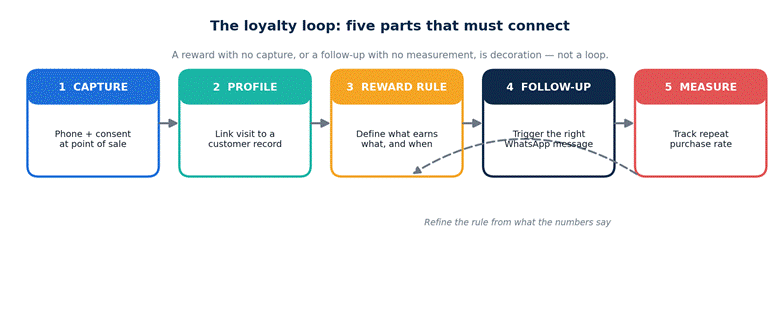
Figure 3. The five-part loyalty loop. A reward with no capture, or a follow-up with no measurement, is decoration — not a loop.
1. Capture — get identity and consent at the lowest-friction moment
The loop begins when an anonymous visitor becomes a known customer. The best moment to capture a phone number is at the point of payment, where the customer is already engaged. The ask must be quick (a QR code to scan, not a long form) and — critically — it must include clear consent to be contacted. Capture without consent is a dead end and, as we’ll see, a legal risk.
2. Profile — attach the visit to a customer record
Each captured customer needs a profile that accumulates their history: what they bought, how often, when they last visited. This is what separates a loyalty program from a discount. The profile is the asset. It is what lets you tell a first-timer from a regular, and a regular from someone who has quietly stopped coming.
3. Reward rule — define what earns what, and when
This is the engine: the explicit logic that says “spend RM50 and earn a stamp,” “reach five visits and unlock VIP,” “birthday month earns a free dessert.” Good rules are simple enough for a customer to understand in one sentence and for your counter staff to explain in one breath.
4. Follow-up — trigger the right message at the right time
A profile and a rule do nothing until they prompt action. Follow-up is the message that brings the customer back: a reminder, a reward notification, a “we miss you” nudge to someone lapsing. In Malaysia this almost always means WhatsApp. The trigger should be tied to behaviour — a customer who hasn’t visited in 45 days gets a different message from one who just earned a reward.
5. Measure — track whether behaviour actually changed
The loop closes with measurement. The point of the program is not sign-ups; it is changed behaviour. If repeat purchase rate is not improving, something earlier in the loop is broken, and the numbers tell you where. Measurement then feeds back into the reward rule — you refine the engine based on what is actually happening.
| Why loops break The most common failure is a program that captures customers and gives rewards but never measures — so the owner cannot tell a profitable program from an expensive habit. The second most common is capturing without consent, which makes follow-up illegal. Fix the loop, not the logo. |
Four High-Impact Loyalty Strategies for Malaysian SMEs
With the structure and the loop understood, here are four specific plays that consistently work for local SMEs. Each is a concrete application of the loop, not a separate system.
Strategy 1: Welcome vouchers structured as return visits, not one-off discounts
A new customer’s first visit is the cheapest moment to lock in a second. The mistake is handing over one big discount — say “RM200 off” — which the customer burns once and forgets. The stronger structure breaks that same value into a series of smaller vouchers redeemable across future visits: ten RM20 vouchers, each with a minimum spend, valid on the next ten visits. The customer perceives generosity; you have engineered ten reasons to return rather than one reason to leave.
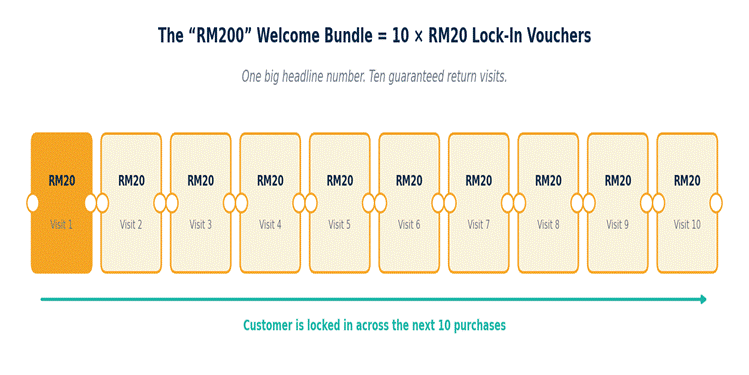
Figure 4. The same RM200 reframed: one discount the customer spends once, versus ten vouchers that pull them back ten times.
Strategy 2: Referral programs that reward both sides asymmetrically
Your happiest customers are your cheapest acquisition channel — if you give them a reason and a way to refer. Three principles make referrals work. First, allocate a real budget: the reward has to be worth talking about. Second, reward both sides asymmetrically — an instant freebie for the new friend (to trigger the first visit) and a milestone reward for the existing customer (to reward the introduction). Third, gamify it with tiers: refer five friends and unlock VIP status. A referral program is just your loop, opened up so existing customers feed new customers into the top of it.
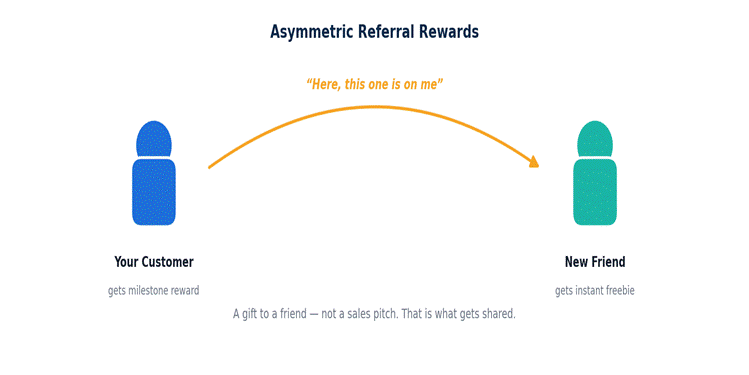
Figure 5. Asymmetric referral rewards: an instant hook for the new customer, a milestone reward for the referrer.
Strategy 3: Birthday rewards that drive group spend
A customer’s birthday month is their highest-spending, most celebratory window — and they rarely celebrate alone. A birthday reward designed for groups multiplies its own cost back in revenue: “the birthday star eats free when they bring three paying friends” turns one free meal into a table of four. It also flatters the customer publicly, which is its own kind of marketing. This only works if you captured the birthday at sign-up — another reason the profile matters.
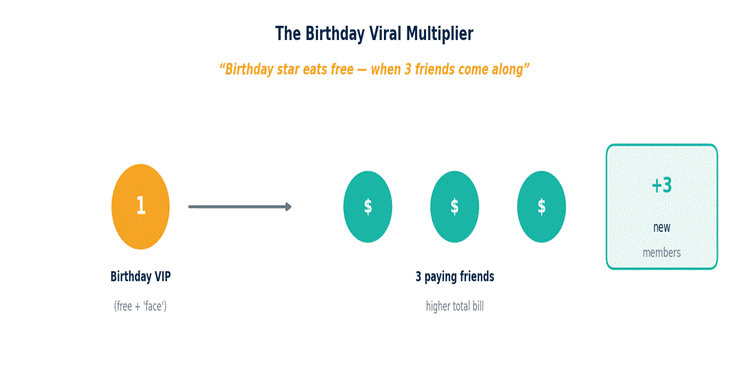
Figure 6. A group-structured birthday reward turns one free item into a full table of paying guests.
Strategy 4: Win-back campaigns for lapsing customers
Some of your most valuable customers are the ones who have quietly stopped coming. Because retaining is far cheaper than acquiring, winning back a lapsed regular is one of the highest-return actions a loyalty program can take. The mechanic: automatically flag customers who haven’t visited within their normal cycle, and trigger a “we miss you” reward before they’re gone for good. This is impossible without the profile and the measurement steps of the loop — you can only win back customers you can see slipping away.
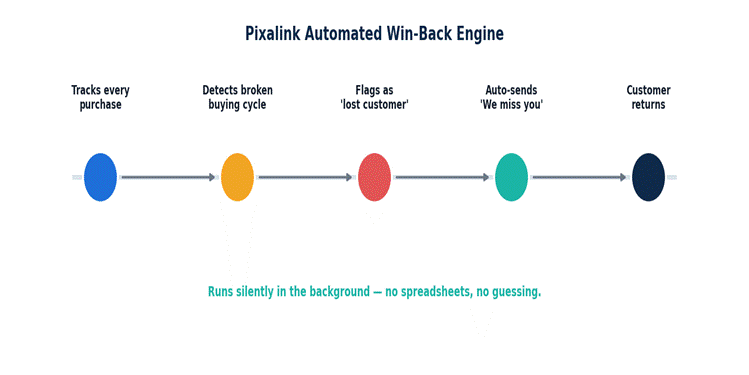
Figure 7. A win-back sequence: detect the lapse, reach out, reward the return — automatically.
The Metrics That Keep a Loyalty Program Honest
Sign-ups are a vanity metric. A program with 5,000 members and no repeat visits is worse than one with 500 members who come back monthly. To know whether your program is working, track behaviour, not headcount. These are the numbers that matter.
| Metric | What it tells you | What to do with it |
| Repeat purchase rate | The share of customers who buy again. This is the lead metric — the single number that says whether the program changes behaviour. | Review monthly. Compare members vs non-members and first-timers vs returning. |
| Redemption rate & quality | Whether rewards are actually used, and whether they’re useful without being too costly. | Watch alongside margin and basket value. Low redemption means a weak reward; high redemption with falling margin means it’s too generous. |
| Inactive customer count | How many members have lapsed past their normal cycle. | Feed straight into win-back campaigns. A rising count is an early warning. |
| Reward cost / margin impact | What the program costs against the revenue it brings back. | If repeat rate rises but margin falls, the reward is too rich. Re-cost the rule. |
| Customer lifetime value (CLV) | The total a customer is worth over the whole relationship. | The number that justifies the program. A small lift in repeat rate compounds into large CLV gains. |
Read these together, not in isolation. The diagnostic pattern is simple: if sign-ups rise but repeat rate doesn’t, the program is too weak after the first visit. If repeat rate rises but margin falls, the reward is too generous. If messages go out but opt-outs climb, the follow-up isn’t useful enough. Each combination points to a specific part of the loop to fix.
Loyalty Programs and the Law: PDPA Compliance in Malaysia
A loyalty program is, by definition, a personal-data operation: you collect phone numbers, track purchases, and send marketing messages. In Malaysia that puts you squarely under the Personal Data Protection Act 2010 (PDPA), which was significantly strengthened by the Personal Data Protection (Amendment) Act 2024, rolled out in phases through 2025. Compliance is not optional, and the penalties are no longer trivial. This section is a practical orientation, not legal advice — but every Malaysian SME running a loyalty program should understand the essentials.
What changed in the 2024 amendments
- Higher penalties. The maximum fine for breaching the data protection principles rose from RM300,000 to RM1,000,000, with imprisonment of up to three years.
- Mandatory breach notification. If personal data is lost or exposed in a way likely to cause significant harm, you must notify the Commissioner — within 72 hours under the breach-notification guidelines — or face a separate penalty.
- Mandatory Data Protection Officer. From 1 June 2025, both data controllers and data processors meeting the thresholds must appoint a DPO and notify the Commissioner.
- “Data user” is now “data controller,” biometric data is now sensitive personal data, and customers gained a new right to data portability.
Consent is where most SMEs get caught
The part of the law that bites loyalty programs hardest is consent for marketing messages. If you collect a phone number on a sign-up form that never mentioned WhatsApp marketing, then message that customer a Raya promotion, you may be in breach — even though they joined your program willingly. Valid marketing consent under the amended PDPA must be:
- Specific: it must name the channel (WhatsApp) and the purpose (marketing). A vague “we may contact you” is not enough.
- Informed: the customer should understand what messages they’ll get and roughly how often.
- Freely given: you cannot make marketing consent a condition of buying or joining.
- Separate by purpose: transactional messages (a booking confirmation) and marketing messages (a promo) need distinct consent.
- Recordable: you must be able to prove when and how consent was given. Under the Act, the burden of proof sits on you, the business — not the customer.
| Practical takeaway Build consent into the capture step of your loop, not as an afterthought. The sign-up moment should record a clear, specific, separately-ticked agreement to receive WhatsApp marketing — and store that record. A loyalty platform that captures and logs consent correctly is doing compliance work for you; a paper form in a drawer is a liability. |
The seven PDPA principles — General, Notice & Choice, Disclosure, Security, Retention, Data Integrity, and Access — all apply to the customer database your loyalty program builds. In practice that means: tell customers what you collect and why, keep it secure, don’t keep it longer than needed, keep it accurate, and honour requests to access, correct, or withdraw. Customers also have the right to stop you using their data for direct marketing at any time, so an easy opt-out is not just courtesy — it’s required.
Common Loyalty Program Mistakes — and the Costliest One
Most loyalty programs that disappoint do so for predictable reasons. The recurring mistakes:
- Launching before deciding which behaviour should change. “We should have a loyalty program” is not a goal. “We want first-timers to come back within 30 days” is.
- Counting sign-ups instead of return visits. Members who never return are a cost, not an asset.
- Capturing data without consent. It breaks the loop and breaks the law simultaneously.
- Over-generous rewards that erode margin. A program that lifts repeat visits while losing money on every one is not a win.
- Adding complexity too early. Tiers, coalitions, and elaborate point math before the basic loop works.
But the single costliest mistake is choosing a loyalty program purely on price. The cheapest tool is rarely the cheapest outcome. A bargain platform that fails to capture consent properly, can’t segment lapsing customers, or doesn’t measure repeat rate will quietly cost you far more in lost retention and compliance risk than you ever saved on the subscription. The cheapest loyalty program almost always turns out to be the most expensive one. Choose the program that matches your strategy, not the one that matches the lowest price tag.
How to Choose a Loyalty Program for Your SME
Use this as a practical checklist. The right platform should let you answer “yes” to each:
- Does it capture identity and consent in one low-friction step? Ideally a QR scan at the counter that records specific WhatsApp marketing consent.
- Does it build a real customer profile? Purchase history, visit frequency, last-seen date — not just a points balance.
- Can it follow up automatically on WhatsApp? Triggered messages for rewards, reminders, and win-backs, with opt-out handled.
- Does it measure repeat purchase rate? If you can’t see whether behaviour changed, you can’t manage the program.
- Does it help you stay PDPA-compliant? Consent capture, records, and easy opt-out built in.
- Will it grow with you? From a simple stamp card today to tiers or paid membership later, without switching systems.
Where Pixalink Fits
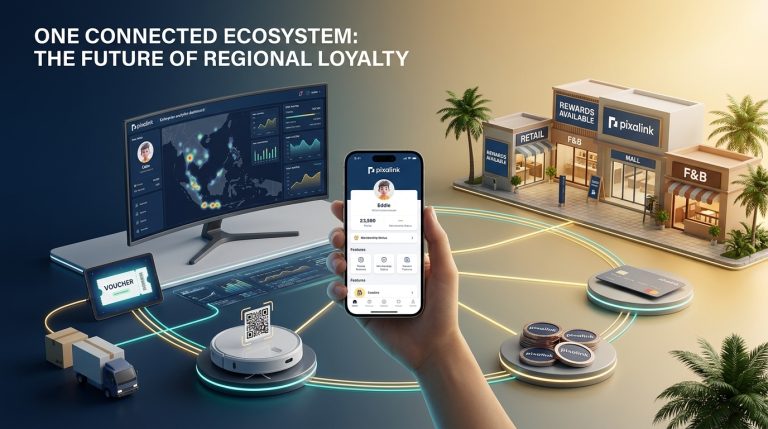
Everything above is true whether or not you use any particular tool. The reason a platform helps is that it makes the loop run as one connected system instead of five disconnected jobs. Pixalink is built for exactly this: a loyalty and CRM platform designed for Malaysian SMEs in F&B, retail, clinics, and salons, where customer profiles, loyalty actions, WhatsApp follow-up, reward controls, and reporting work as a single measurable loop.
In practice that means capturing a customer and their consent at the counter in seconds, attaching every visit to a profile, running any of the structures and strategies in this guide (welcome vouchers, referrals, birthday plays, win-backs), triggering the right WhatsApp message automatically, and watching repeat purchase rate move month over month — with consent recorded the way the PDPA now requires. The educational point comes first; the product is simply the practical way to put the loop into operation without stitching together five tools.
| The bottom line Build the loop before adding decoration. Capture identity and consent, profile the customer, set a reward rule, follow up where your customers actually are, and measure repeat purchase rate. Choose the program that fits your strategy — and treat the cheapest option with healthy suspicion. |
Frequently Asked Questions
What is the best first step for an SME starting a loyalty program?
Pick one behaviour to improve — usually turning first-time walk-ins into repeat customers — then build the smallest possible loop around it: one capture method, one reward rule, one follow-up message. Add structure only once that loop is working and measured.
How much should a loyalty reward cost?
There’s no fixed figure, but the test is margin. Track repeat purchase rate and reward cost together: if repeat visits rise while margin holds, the reward is well-priced; if margin falls, it’s too generous. Start conservative and loosen it only if redemption is too low.
Is a points program or a stamp card better for a small café?
For a small, high-frequency business, a digital stamp card is often the better start — it’s simple, has a visible goal, and (unlike paper) captures customer identity and consent. Points and tiers make more sense once you have volume and want finer control.
Do I really need to worry about PDPA for a small loyalty program?
Yes. The PDPA applies to any business processing personal data in commercial transactions, regardless of size, and the 2024 amendments raised the maximum fine to RM1,000,000. The practical must-do is capturing specific, recorded consent for WhatsApp marketing at sign-up.
How do I know if my loyalty program is actually working?
Look past sign-ups to repeat purchase rate, redemption quality, inactive-customer count, and margin impact. If members return more often than non-members and margin holds, it’s working. If only sign-ups are growing, the loop is breaking after the first visit.
Why is the cheapest loyalty program often the most expensive?
Because a tool chosen on price alone tends to skip the things that create value — proper consent capture, customer segmentation, automated follow-up, and measurement. The money you save on subscription is dwarfed by the retention you lose and the compliance risk you take on.
Pixalink — loyalty, CRM, WhatsApp follow-up and reporting as one measurable loop, built for Malaysian SMEs.